Stone veneer is sometimes treated as a substitute for full-depth masonry, but that undersells what makes it useful. Natural thin stone veneer is real quarried stone cut down to roughly ¾ to 1½ inches thick and, under industry standards, generally kept at no more than 15 pounds per square foot. Full-thickness veneer, by comparison, is commonly 4 to 6 inches thick and can weigh 40 to 73 pounds per square foot. That difference makes real stone practical on walls and structures that would be considerably more complicated to build around full-bed masonry.
Mike Sylvia of Champlain Stone describes the appeal well: thin veneer “can be applied over a wide variety of base substrates” and can go places where traditional stone might be impractical.
Not every available wall needs it. Some of the strongest projects use surprisingly little stone, putting it where texture, visual weight or a connection to the surrounding landscape actually adds something.
1. Take the Fireplace All the Way Up
A fireplace is probably the most predictable use of stone veneer on this list, but designers keep coming back to it for good reason. A relatively small amount of material can change the architecture of an entire room, particularly when the stone continues from the firebox to the ceiling rather than stopping at a conventional mantel height. Natural Stone Institute guidance specifically includes fireplace attachments among its standard vertical-surface details, and stone specialists routinely use thin veneer when the structure cannot reasonably support full-depth masonry.
Choosing veneer early matters, especially when the fireplace sits above a basement or on an upper floor. Bryce Harding of Delta Stone Products recommends checking whether the floor structure is rated for full-bed stone or thin veneer before the design gets too far along. Thin veneer removes much of that weight, although fireplace clearances, substrates and local codes still have to be handled correctly.
Stone pattern changes the feel almost as much as color. Narrow ledgestone emphasizes horizontal lines, while larger square-and-rectangle pieces tend to calm the wall down visually. Natural Stone Institute guidance recommends evaluating aesthetics, finish, physical properties and the exact application rather than treating all natural stone as interchangeable.
2. Cover the Foundation Nobody Intended You to Look At
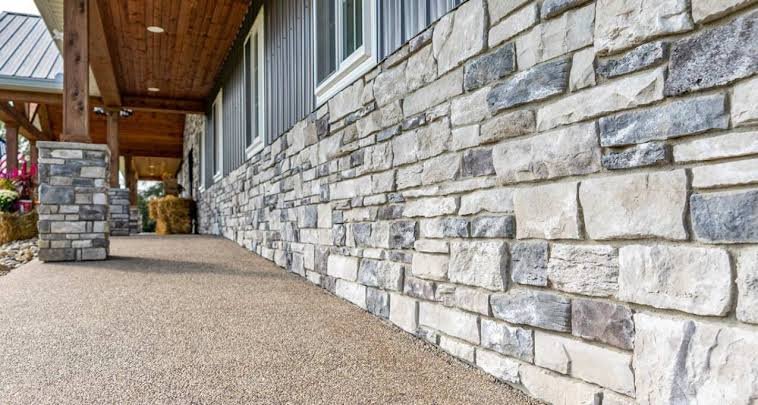
Some houses look completely resolved until you get to the bottom 24 inches and hit a long strip of exposed concrete. Stone veneer can fix that transition by adding visual weight where the building meets the ground. It can stop at the foundation line, continue around porch walls or carry selectively into an entry without taking over the whole facade.
Restraint matters. Veneer tends to look more convincing when it stops at something the architecture is already doing, such as a sill, porch line, change in siding, corner or roof condition. Arbitrary stopping points can make stone look pasted on, especially when it cuts awkwardly across windows or ends mid-wall for no obvious reason.
3. Give Porch Columns Enough Weight to Look Like They Could Actually Hold Something
Skinny posts under a substantial porch roof can make a house feel visually top-heavy. Wrapping the lower portion of those columns in stone veneer adds mass without requiring solid masonry piers. Corner detailing becomes especially important on columns because the installation is visible from several directions, which is why natural veneer systems commonly use corner pieces that return around the edge and help the finished column read as solid stone rather than a thin facing.
Scale matters too. A six-inch-high stone base on a large column usually does very little. When stone is supposed to visually ground the structure, give it enough height and area to actually do the job.
4. Finish an Outdoor Kitchen Without Making It Look Like an Indoor Kitchen That Escaped
Outdoor kitchens need durable vertical finishes, and stone veneer fits especially well because the structural base can do the supporting while veneer provides the visual connection to the rest of the property. It works on islands, bars, grill surrounds and cabinet bases, particularly when the same stone or a related material appears elsewhere in walls, patios, fireplaces or boulders.
Landscape designers Maureen Gilmer and Sarah Hutchinson recommend carrying color, texture or pattern from the kitchen into surrounding landscape materials rather than treating the cooking area as a completely separate object. One example they highlight uses thin stone on the kitchen and larger slabs around an adjacent fire pit, letting the same material language show up at different scales.
Deck builder Clemens Jellema has watched outdoor kitchens move from novelty to expectation. When he started building decks more than 20 years ago, they were unusual; today, more than half of his firm’s deck designs include one. Stone veneer helps those kitchens feel architectural rather than appliance-heavy, while heat protection, weatherproofing, fire-rated assemblies and structural framing still have to be handled behind the finish.
5. Use It on One Interior Wall Instead of Four
Natural stone already carries a lot of visual information. Color changes from piece to piece, faces vary, joints create their own pattern and lighting exaggerates texture throughout the day. Covering every wall can turn a strong material into background noise.
One wall is often enough.
An entry wall, stair landing, dining-room feature, wall behind a freestanding tub or the long blank surface in a great room can all take advantage of real stone without turning the interior into a lodge. Pattern deserves almost as much attention as the stone itself. Ledgestone tends to pull the eye horizontally, while larger square-and-rectangle formats can feel quieter and more architectural.
Read More: How to Modernize an Older Character Home Without Losing Its Original Charm
The Rock Garden makes a similar distinction with its natural veneer, dividing material into sawn, chop and random patterns. Sawn pieces produce cleaner lines, chop patterns retain more hand-worked texture, and random stone keeps more of its original irregular shape. That decision can influence the finished room more than choosing between two nearly identical shades of gray.
6. Make the Chimney Look Like Part of the House
A chimney is visible from multiple sides of a property and can either feel integrated into the architecture or like something everyone tried to ignore. Stone veneer can turn it into one of the exterior anchors instead.
Material selection matters more here than an inspiration photo. The Natural Stone Institute cautions that while natural stone is generally durable, not every stone variety is equally suited to exterior exposure. Stone should have a record of performing successfully in the local climate, particularly in places dealing with repeated freeze-thaw cycles.
Color and pattern still matter, but absorption, weathering, flashing, drainage and transitions around roofs and openings deserve equal attention. Exterior veneer is part of a wall assembly, not merely stone attached to the side of a building.
7. Put Stone at the Entry Before You Put It Everywhere Else
A project with enough budget for 250 square feet of veneer rather than 2,500 can still have plenty of impact. Concentrating stone around the front entry may do more visually than spreading a narrow band around the entire house. Architects use natural stone this way because it can create a sense of permanence without overwhelming the larger composition, and professionals commonly cite durability, longevity and compatibility with surrounding architecture among the reasons for using stone veneer.
An entry also gives designers several surfaces to work with at once: the wall surrounding the door, porch columns, seat walls, wing walls and nearby foundation. They do not all need veneer. Picking one or two usually creates a stronger result than outlining every architectural feature in stone.
Modern houses do not need rustic stone simply because the material is natural. Clean sawn veneer with tight horizontal lines can suit contemporary architecture far better than intentionally rough rubble stone.
8. Give a Plain Concrete Landscape Wall a Better Face
A structural retaining wall still has to manage soil pressure, drainage, footing conditions and whatever engineering the site requires. Stone veneer does not replace any of that. It simply changes what people see.
Veneer works well over appropriate concrete or masonry surfaces on retaining walls, raised planters, seat walls and other vertical landscape elements. The top of the wall deserves just as much thought as the face, since caps and coping have their own anchorage and water-shedding requirements.
A veneered wall with a substantial natural cap usually reads as masonry. Leave an exposed concrete top, and the wall can still look like a dressed-up concrete structure.
9. Remodel Something That Was Never Designed for Full Stone
Thin veneer becomes especially useful during remodeling because it dramatically reduces the weight compared with traditional full-bed stone. Natural thin veneer is generally cut to remain under the 15-pound-per-square-foot adhered-veneer threshold, while traditional full-thickness stone can weigh roughly 40 to 73 pounds per square foot.
Greg Osterhout of Northern Stone Supply points out that the lighter material can eliminate some of the additional footing or engineering demands associated with full veneer, “leaving options wide open for remodels [and] retrofits.”
That opens up possibilities on existing fireplaces, older home exteriors, additions, entry walls and other structures where owners want real stone without rebuilding around the weight of traditional masonry. The substrate and wall assembly still have to support the installation properly, but thin veneer makes far more renovation scenarios practical.
10. Use Veneer to Connect the House to the Landscape
One of the most interesting uses for stone veneer is not another wall at all. It is repetition.
Suppose the entry uses natural stone. The same material can appear again on an outdoor-kitchen base, low garden wall or fireplace across the patio. It does not need to cover every surface between those points. A few deliberate repeats are usually enough to make the architecture and landscape feel related.
Architect Larry Boerder has said that he favors locally sourced natural stone in part because local material can make economic sense by reducing transportation costs. Local stone can also make aesthetic sense. Material quarried in the same region as the project often relates naturally to the colors and geology of the surrounding landscape.
That advantage becomes especially relevant when choosing a natural stone veneer supplier instead of selecting a manufactured pattern from a catalog. The Rock Garden produces much of its own material at Willownook Quarry near Laporte, Colorado, and cuts natural veneer into sawn, chop and random patterns for different architectural effects. A stone selected for the house can become part of a broader palette that extends into walls, steps, boulders and other landscape features without forcing everything to match exactly.
The Best Use May Be Less Stone
Professional stone design tends to start with application rather than color. The Natural Stone Institute teaches architects and designers to evaluate physical properties, testing, installation type and interior or exterior conditions before settling on a material. That process usually leads to better decisions than beginning with an inspiration photo and trying to reproduce it on every available surface.
Read More: The Complete Guide to Restoring and Modernizing a Heritage Home
Stone veneer works because it can add visual mass without becoming the structure itself. It can make a porch column feel heavier, turn a framed fireplace wall into a focal point, finish a concrete landscape wall or bring real quarried stone into an older house that was never engineered for traditional masonry.
The temptation is to measure its impact in square footage. Placement matters more. A well-chosen 100 square feet around an entry, fireplace or outdoor kitchen can do far more for a design than several times that amount installed simply because a wall happened to be empty.

More Stories
Common Mistakes When Tiling a Floor
TYPES OF HARDWOOD FLOORING TO CHOOSE FROM